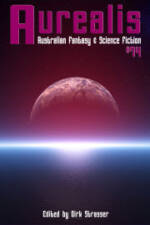
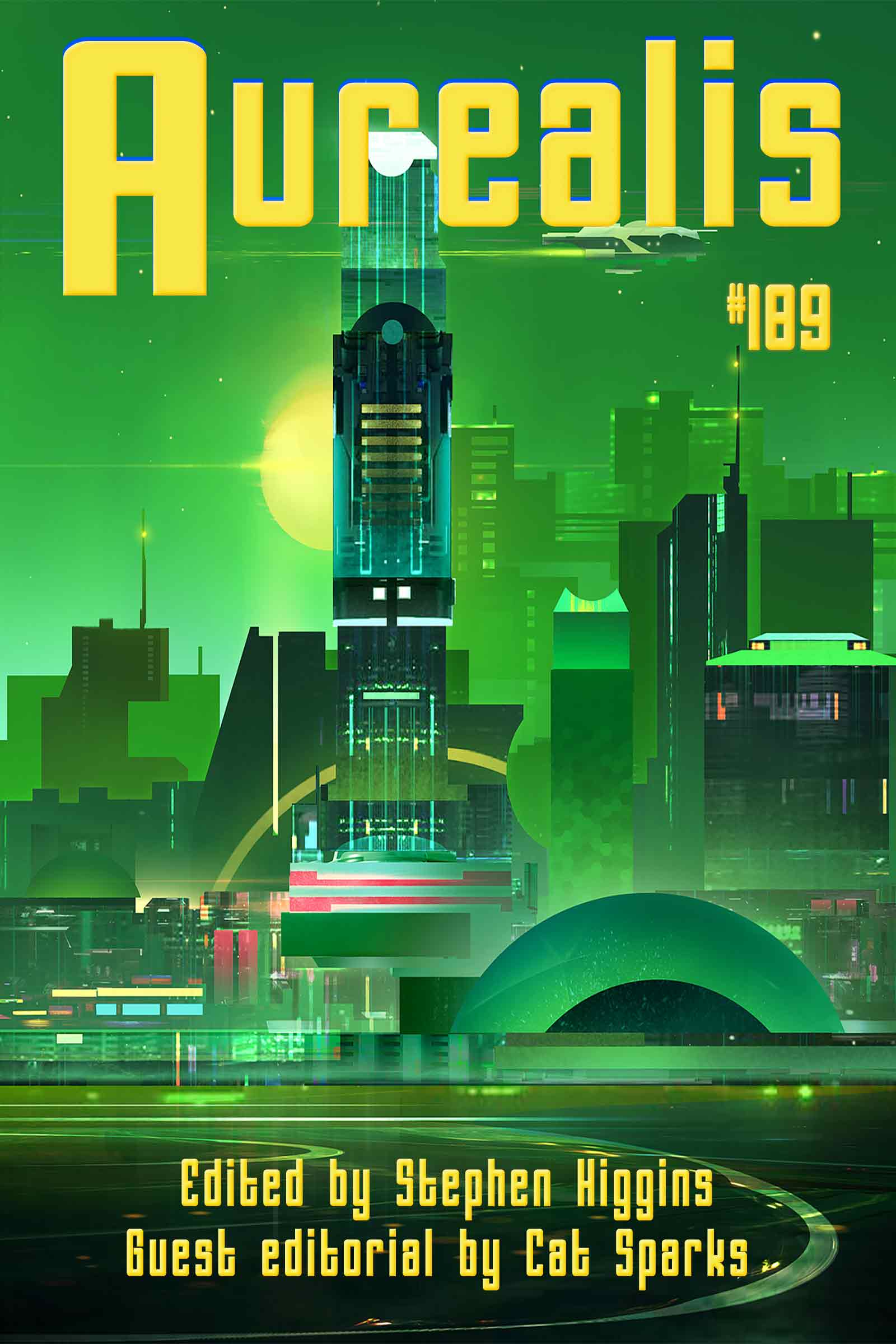
Aurealis #189
$3.99
- From the Cloud — Stephen Higgins
- Out of Time — Carolyn Galbraith
- Little Drid Makes a Call — Andrew Renganathan Roberts
- Epimetheus — Luke Weavell
- William Walker, His Fiction and Now-Solved Mystery — Gillian Polack
- Fallout as Critical Retrofuturism — Ani White
- Building Empires and Stories: A Conversation with Nicola Zhang — Natalia Soriano
From the Cloud: Guest Editorial
Cat Sparks
Outpacing the Great Filter and Other Paradoxes
So, what is science fiction anyway and what evidence do we have that it still exists?
We all know what it used to be, from the blunt, tropes-only spectrum end (all shiny action rockets, robots and ray guns), right through to the sharpened, pointy tip resplendent with massive scientifically techno-plausible, brain-melting concepts.
Kim Stanley Robinson considers science fiction to be, amongst other things, a modelling exercise, or a way of thinking. Which made it a logical response to the mid-20th century Great Acceleration—a dramatic surge in human activity and its planetary impact encompassing various social, economic and environmental changes.
For a time there, much contemporary SF* seemed to riff thematically off Mary Shelley’s Frankenstein, with characters pushing methodological boundaries, ensuring buckets of chaos and baked in conflict.
Not just ‘what if?’, but ‘what if things go wrong?’
Cue real-life 2026, where traditional SF staples such as brain–computer interfaces, gene editing, humanoid robots, lab-grown meat, self-driving cars, reusable rockets, augmented reality glasses, digital humans and AI avatars, smart homes, consumer drones and AI companions with extremely attached and emotionally invested human users are already yesterday’s news.
Meanwhile, the global race to stuff AI into everything, despite the tech being fundamentally unreliable, is on.
The use of AI in warfare has leapfrogged the theoretical—it’s on the battlefield in Iran and Ukraine, despite its problems with visual cognition and struggles with tasks requiring precise spatial information when geometric primitives overlap or are close. It’s deeply embedded in the process of collecting intelligence and using it to shape strategic decisions. The Chinese government already tasks companies with developing mass disinformation and surveillance tools for tracking dissidents. No country’s existing laws are fit to regulate AI.
Back home, frontier AI models are showing signs of self-preservation in experimental settings. AI social platforms like Moltbook are potential accelerators of existential risk—a space where AIs can compound capabilities and coordinate at scale.
KSR reminds us that ‘Science fiction is the realism of our time. Utopia and dystopia are both possible, and both staring us in the face.’
Damn straight they are. Was a global nuclear renaissance on your bingo card?
Putin has already tested his tsunami-making nuclear weapon. Chinese robots have learnt to run up walls. Corporations boast of reshaping battlefield technology, turning soldiers into ‘technomancers’, armed with tools that expand human capability through intelligent, wearable computing.
Advances in neuroscience, pharmacology and AI are merging to create a new threat: the human brain itself as battlefield (anyone remember Barefoot in the Head?). The tools to manipulate the central nervous system—to sedate, confuse or even coerce—are becoming more precise, accessible and militarily attractive.
Programmable matter, synthetic embryos and life, gene edited designer humans, deepfakes and synthetic people, digital clones that can persist beyond your death. The techbro with plans to launch a dedicated bitcoin mining rig into space. And then there’s the fun stuff: time crystals you can see; robot bunnies deployed to fight invasive pythons; birds beeping and booping like R2-D2; a Japanese tech giant deploying laser drones to protect chickens; chickpeas cultivated in simulated lunar soil; AI helping scientists design fruit more efficiently. But I digress…
If SF itself is becoming functionally obsolete, what happens to its authors, presuming there’s still space for such anachronisms in the AI-befouled communication extrusion business?
A few more words from KSR: ‘So one lens of science fiction is a real attempt to imagine a possible future. The other lens is a metaphor for the way things are right now. What you get when the two coalesce is a vision of historical time, cast into the future. Like a trajectory of deep time.’
Maybe our job is filling the gap between the SF-surpassed now and that far, far fantasy future. Unpacking interstitial spaces and injecting humanity, rebellion and resistance, championing the best and fighting back against the worst. Solarpunk, Hopepunk, call it whatever you like. I’m thinking of SF lending its skill set to iterations of the Overview Effect, as the literature of far-thinking, community-focused, enriched, connective, collective, activist, enhancement.
To understand the Great Filter, an implication of the Fermi Paradox that places humanity observably faltering at Step 8, teetering on the brink of resource exhaustion and self-annihilation, is to comprehend the likelihood that complex life, let alone intelligent life, is very likely a great rarity in the universe. This implies a duty to stand up and fight back against the very stable geniuses and other billionaire bunker-building garbage one-percenters who, having driven the frothing furies of late-stage capitalism completely into the abyss, are content to huddle underground in luxury to watch it burn.
Doesn’t it?
*Anything set in the far, far future without any plausible inkling as to how humanity survives the Fermi Paradox-soaked present gets filed rigorously under fantasy IMHO.
Links
Barefoot in the Head by Brian Aldiss
https://www.hachette.com.au/brian-aldiss/barefoot-in-the-head
The Fermi Paradox and Great Filter
https://en.wikipedia.org/wiki/Fermi_paradox
The Overview Effect
https://en.wikipedia.org/wiki/Overview_effect
Kim Stanely Robinson: The Realism of Our Times
The Realism of Our Times: Kim Stanley Robinson on How Science Fiction Works
All the best from the cloud!
Cat Sparks
From Out of Time by Carolyn Galbraith:
I settle myself in the chair beside the bed. The figure has been piled with blankets, as though his carers know he’ll be cold, too cold, very soon. I can barely see him in the gloom, although there is a thick beeswax candle balanced on a small table by the door, and another on the dresser in front of the mirror.
I don’t need to see him, of course. I’m briefed before I’m sent, and I know this man well. It’s Oscar Wilde, and he’s about to die.
You’d think people would rarely be left alone in those moments, but it happens: that the loved one or the servant assigned to watch over the sickbed does need to go. I’d say we arrange it like that, although how, I know not; it isn’t my job. My job is to arrive in the empty room while the last breaths are being taken.
They’re rarely conscious, but that doesn’t seem to matter. I sit beside them, take their hand, and I talk to them. I have a low, quiet voice that I use here, in the rooms of the sick. I tell them that in the future they’re remembered with admiration. Their work is discussed deeply, and enjoyed. I tell Oscar Wilde that his plays will be performed, his stories read and his queerness celebrated, not punished. I tell him that he’s already made a difference.
The breaths come further apart. There’s so little oxygen passing through the lungs and the blood and the brain that the person has, in a sense, already gone. He’s drifted away now, and I pick up the skirts of my robes and head back through the door.
The door in question opens, only to me, onto another room. A closet, really. A fine, hot wind blows through me and then I step out into a cheerful chamber. Not a laboratory as some might think, just a quiet garden office, with Mrs Murchinson behind her desk, and a lounge and a bookshelf. There’s a kettle on a trolley with milk and biscuits, and it whistles moments after I arrive, reminding me to make my tea. Glass sliding doors open onto a courtyard with wisteria in spring and hellebore in winter. There’s a bench out there to sit on, so you can listen to the bees.
‘You’ve done George Crabbe, Rachel Carson and Oscar Wilde this week,’ Mrs Murchinson observes. ‘Perhaps you’ve a poetical soul?’
From Little Drid Makes a Call by Andrew Renganathan Roberts:
‘Hey Little Drid. You holding? This is all I’ve got. Please, brother. You gotta help me out.’
‘Think you could sort me out today, Drid, my man? I’m a little light today. Best not tell Melcolm though. We’ll keep this between us.’
‘How much you say? Bah! What makes you guys so special you gotta charge so much, huh? Tell Melcolm he can eat shit. Unless you want to help a sista out, hmm? Melcolm doesn’t need to know. This can be our little secret. I can make it worth something to ya. Whatta say, Drid?’
The boy’s heard it all before. The pandering. The excuses. There’s been so many over the years they’ve begun to calcify over his skin, creating a shield around his skinny frame that’s as hard as bone.
From Epimetheus by Luke Weavell:
Darwin found the stowaway, flashlight pointed into the steel rafters of the lower deck. There, threaded between metal beams, glinted the first strands of a cobweb. The spider scurried along the silk, black and shiny and frantic.
‘Found him,’ she muttered. ‘Big one.’
‘Where?’ Cook frowned, searching. ‘I don’t see it.’
Darwin grunted, pointing at the spider.
‘Gross.’ Cook leaned into the radio mounted on his shoulder. ‘This is Cook, got a stowaway in Corridor Six, outside Engineering. Please advise.’
The radio crackled: ‘Species?’
‘It’s a, uh… Fuck, I don’t know. A spider.’
Silence. Then: ‘Please wait.’
From William Walker, His Fiction and Now-Solved Mystery by Gillian Polack:
Walker’s life was interesting and how it underplayed with his writing is worth exploration, but that’s not the focus in this article. The focus here is on one very specific aspect of his life. This aspect was long forgotten. It was thrown into our world because a German academic saw his work as Australian Gothic. This is the story of how we discovered what Walker looked like. The speculative component in his work is the cause of this discovery, which is a nice twist.
From Fallout as Critical Retrofuturism by Ani White:
Retrofuturism, an outlook that embraces the past’s view of the future, runs the risk of sacrificing critical thought to nostalgic aesthetics. The Fallout TV series (2024–) both indulges in retrofuturistic aesthetics and reflexively satirises their embedded politics. The series satirises both 1950s-style ‘atompunk’ aesthetics, and the various factional nostalgias that prevent social advancement in the post-nuclear Wasteland
From Building Empires and Stories: A Conversation with Nicola Zhang by Natalia Soriano:
I had the pleasure of interviewing Nicola Zhang and delving into her craft to inquire about her inspiration for creating the Celestia series universe, and to discuss her journey as an independent author in today’s market. Nicola shared how her historical fiction background helped shape the book’s characters, as well as their personal battles. Additionally, we discussed the challenges that independent authors face, as well as the benefits and knowledge that they gain.