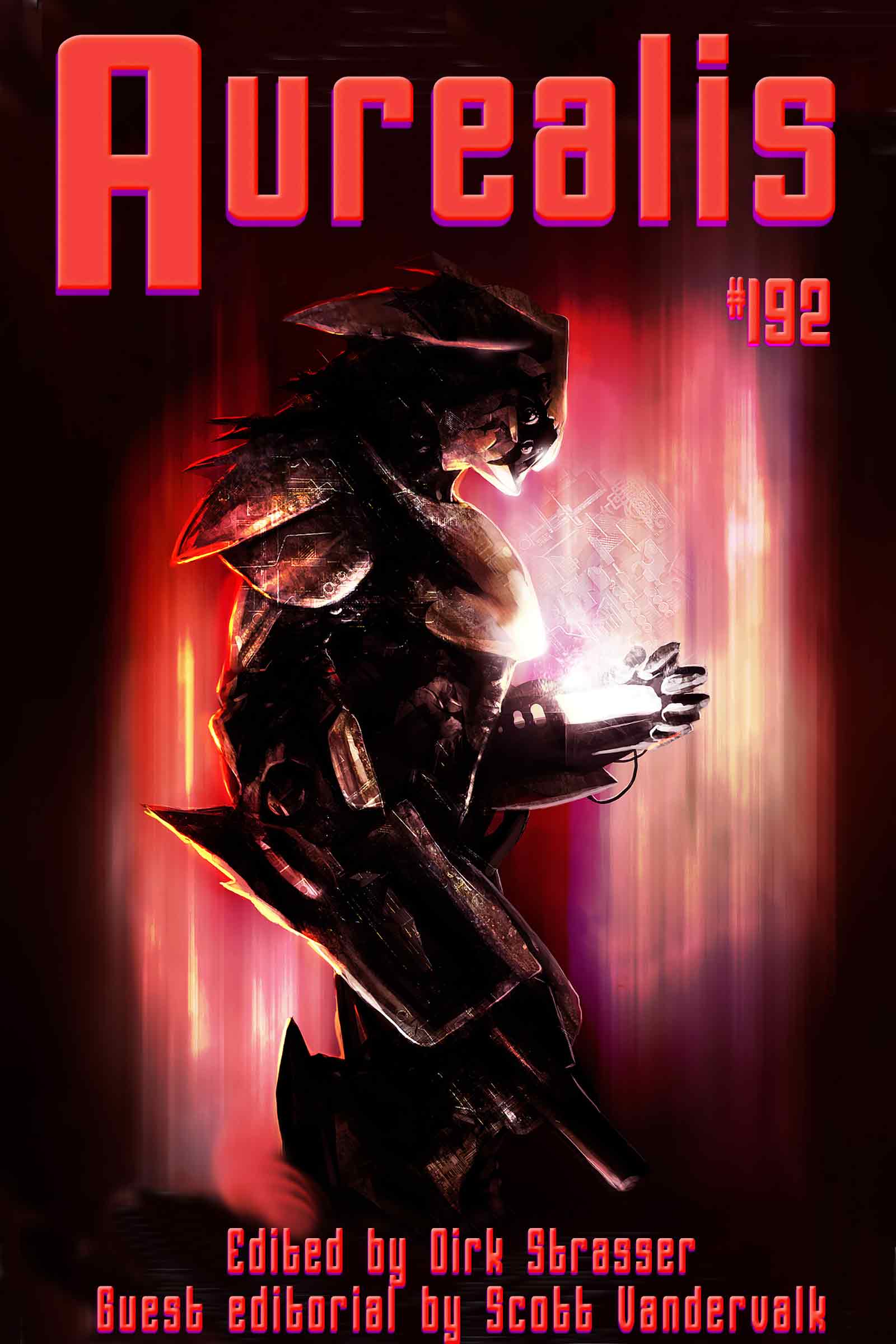
Aurealis #192
$3.99
Our July 2026 issue opens with a guest editorial by Scott Vandervalk who shares his search for new hooks in fantasy stories. Aurealis #192 features the captivating ‘The Square’ by EL Edwards, the disquieting ‘Sons & Fathers’ by Ben Peek and the unsettling ‘Tethered’ by John Mavin, with stunning illustrations by Josh Hardie, Zuzanna Kwiecien and James Spence respectively. Our intriguing non-fiction includes ‘What Science Fiction Gets Wrong about Colonising Mars by Daniel Thompson’, ‘Potatoes Don’t Go There: Medieval Cuisine and its Portrayal in “Medieval European” Fantasy’ by Annie Mills and ‘KPop Demon Hunters (2025): The Politics of Murdering Demons’ by Ani White. Add to this our bumper Reviews section for the latest in genre reading and you have a cornucopia of SFF delights!, to infinity and beyond!
- From the Cloud — Dirk Strasser
- The Square — EL Edwards
- Sons & Fathers — Ben Peek
- Tethered — John Mavin
- What Science Fiction Gets Wrong about Colonising Mars — Daniel Thompson
- Potatoes Don’t Go There: Medieval Cuisine and its Portrayal in ‘Medieval European’ Fantasy — Annie Mills
- Kpop Demon Hunters (2025): The Politics of Murdering Demons — Ani White
Guest Editorial: Scott Vandervalk
I’m always searching for new hooks into a fantasy story. Over the years, I’ve read so, so many books and series about Tolkienesque or British-medieval fantasy worlds. These types of settings have their place. I grew up with many of those books so, perhaps, they’ve served as a baseline in my reading over the years, even more so now while I look for stories that push fantasy in new directions or have a different take on something familiar.
Brandon Sanderson’s Mistborn (or Mistborn: The Final Empire) didn’t do much beyond baseline fantasy for me. Sure, the series starts with the bad guys already having won, which was a change-up I could get behind but, perhaps, I’d read too much otherwise similar fantasy for it to gel for me at the time. While its magic system sparked my attention, I’m not into reading just about magic systems as my main hook.
When I read NK Jemisin’s Broken Earth trilogy, it was a breath of fresh air—its setting is a future-fantasy world broken by catastrophe. There are elements of fantasy, sci-fi and post-apocalypse (with climate fiction parallels) all woven together in a compelling prose that gave me something new. The ‘comms’ and ‘use-castes’ of the Stillness’s society particularly struck me in a way I hadn’t read in a while.
Joe Abercrombie’s The Devils is set in a medieval Europe, but it’s an oddly alternate medieval Europe. There are parallels with the Europe of our world (Troy, the Holy City, Venice), but then all this other stuff (vampires, werewolves, elves and all kinds magic, including their impacts on the setting) is in there as well, tweaking it much into its own world. Its dark humour and compelling characterisations are what carried me through the book, but I was always keen to see what might have been similar to our Europe’s history and what was different.
Dirk Strasser’s Conquist is set briefly in a version of our world during the conquistador invasion of the Inca Empire, right up until its characters are drawn into another world—a fantastical place with its own rules, and its demon-like and angel-like beings. I appreciated, in particular, the initial unknown of the setting, as our characters pushed into the new world, exploring it and finding out about it at the same time as the reader did.
China Mieville’s Bas-Lag books gave me a heady mix of weird fantasy with magic (thaumaturgy) and steampunk, but it drew on so many other elements in its setting and narrative (horror, fantasy and sci-fi). Mieville’s The Scar still burns in my mind as one of my favourite all-time books but, perhaps, I’m due to re-read this after a twenty-year, or so, absence.
Then there’s Naomi Novik’s Temeraire series (alternate history fantasy with Napoleonic War and dragons… where do dragons from all over the globe fit in, what does it change about that war?) and also Novik’s Scholomance series (an alternate version of our world where ‘mundanes’ and magic-users exist alongside each other, and the magic school of the setting seems out to kill its students).
I’m next up to read Navola by Paolo Bacigalupi, set in a Renaissance-era Italian-inspired fantasy world. I’ve long enjoyed his cli-fi stories so I’m keen to see where his fantasy story might go.
What kinds of tweaks have you enjoyed in your fantasy stories?
All the best from the cloud!
Scott Vandervalk
From The Square by EL Edwards:
The bodies were plain to see, even before The Square came into view. Lieutenant Damien Horstmann saw them strewn about, forming an ugly stain on the planet’s otherwise featureless grey surface. Three months of spaceflight, all for this, and finally he’d made it.
From Sons & Fathers by Ben Peek:
At around ten, I remembered that I had a bag of cheap tobacco in my truck. I’d had a few beers by then. Nothing serious but I was working on it. I was trying not to think about my ex-wife, Maya. She’d called from Sydney the night before to talk about our son. He’d been in a fight. It was the second or third time, I don’t know, but this time he had a knife. He was only seven.
From Tethered by John Mavin:
My wife’s first death is happening much too quickly. The unborn child I begged her not to carry went still this morning, the growth on her neck has darkened and, worst of all, her five-year-old daughter hasn’t come home yet.
From What Science Fiction Gets Wrong about Colonising Mars by Daniel Thompson:
The Expanse is one of the ‘harder’ sci-fi shows of recent years. Issues like adapting to low gravity environments aren’t skipped over—they are essential elements of the plot! But even this show fudges a lot of the details when it comes to colonising the solar system.
From Potatoes Don’t Go There: Medieval Cuisine and its Portrayal in ‘Medieval European’ Fantasy by Annie Mills:
We’ve all seen it, even if we didn’t know it at the time. A fantasy movie shows our intrepid protagonist, just starting their journey in their Medieval-style town, and they’re handed a big bowl of stew with what looks like green beans floating in there.
From Kpop Demon Hunters (2025): The Politics of Murdering Demons by Ani White:
KPop Demon Hunters (2025) is a work of popular fantasy that foregrounds diasporic Korean talent, and reworks Korean mythology into a contemporary context. Yet the story introduces complications, which it ultimately abandons, particularly the suggestion that demons are not inherently evil.