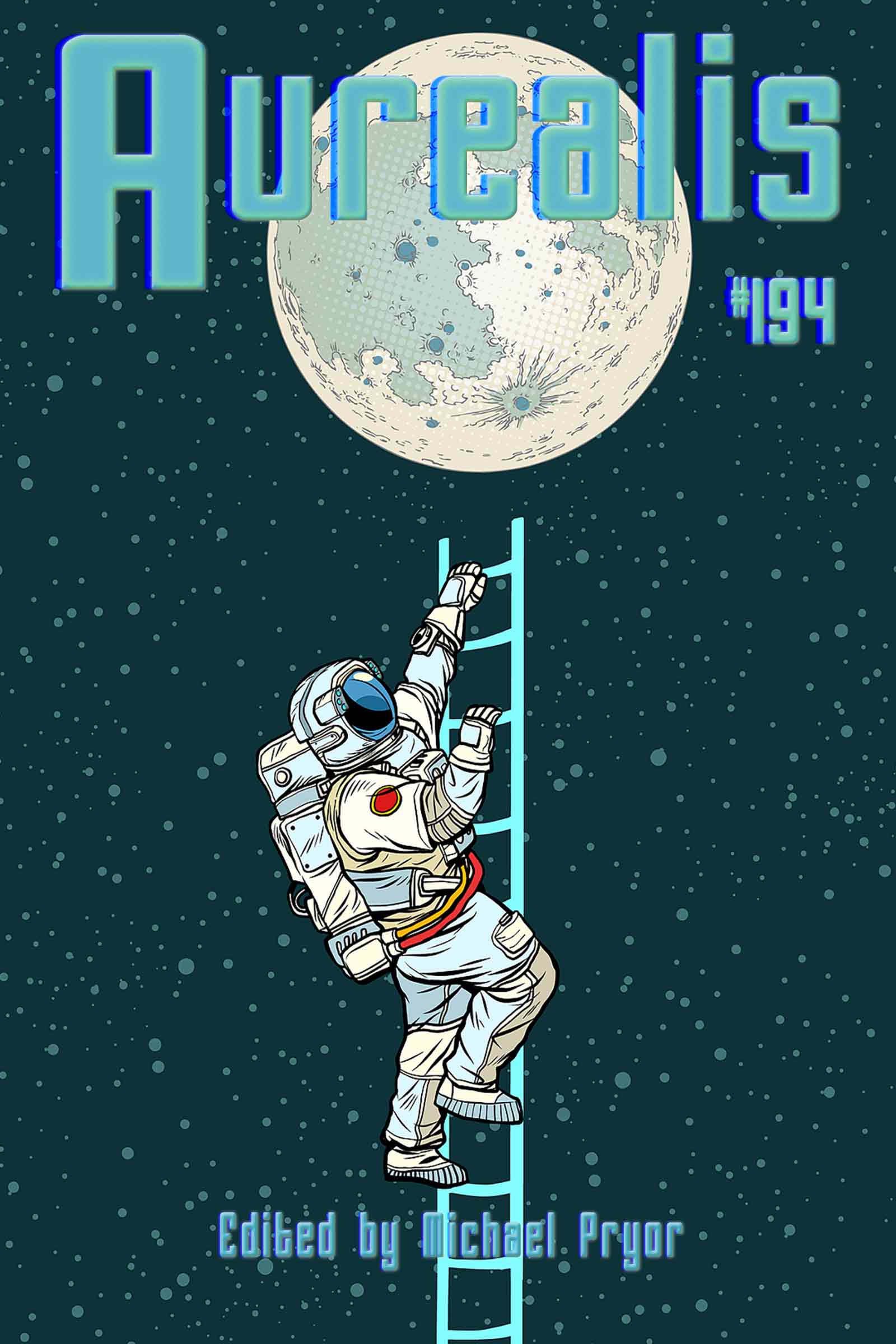
Aurealis #194
$3.99
Aurealis #194 has sensational fiction from Cameron Semmens, C.H. Pearce and Benjamin George Coles with illustrations from Matt Bissett-Johnson, Chris Catlin and Joel Bisaillon. Our wide-ranging non-fiction is from Lynne Lumsden Green, Annie Mills and Ani White. Plus our reliably insightful Reviews section. Aurealis, the choice of all enigmatic obelisks!
- From the Cloud — Michael Pryor
- Boy Leaves Girl Inside a Giant Octopus — Cameron Semmens
- Form a Shape, Besides Yourself — C.H. Pearce
- The Vineman of Nancy — Benjamin George Coles
- How Pop Culture and A.I. Interacted from 2000 to 2025 — Lynne Lumsden Green
- Who put all these tentacles in my eldritch horror story? — Annie Mills
- Conservative Mythology in Weapons (2025) — Ani White
Let’s put aside the differences between the US and the rest of the world in the way ‘alternative’ and ‘alternate’ are used and simply understand that ‘alternative history’ is the more accurate term before we go on. Good? Done? Excellent.
Alternative histories are where the writer changes something in our past and imagines what difference it would make to our present. For example, because of the gold rush, Australia in the 1880s was the richest country in the world. But the gold ran out. What if it didn’t? What if today Australia was the richest, most powerful country in the world, dominating politically, economically, technologically, and in the media? What sort of a world would it be?
It’s like dropping a stone into a pond and watching the ripples spread. With alternative histories, the longer ago the event was, the further the ripples spread and the more impact they have. Imagine, for instance, if Cleopatra’s navy had defeated the Romans at the Battle of Actium in 31 BC? We could be living in a world where Egypt is the superpower! What would living in an Egyptian world be like?
A good alternative history looks at the implications of a historical change, but without sacrificing narrative and character. In fact, the changed circumstances can provide a fertile ground for exploring such aspects of story. How would a person behave in a world where the Reformation and Enlightenment didn’t happen, and where religious conformity is paramount? What would be the large-scale, society-wide differences? What would be the more intimate, personal differences? In such, narrative grows.
But where are our Australian alternative history novels? John Birmingham is perhaps the most notable author working in this area with his hugely enjoyable Axis of Time series, but how about others? A Bertram Chandler, an Anglo-Australian author prominent in the 1950s, had a stab at the sub-genre with Kelly Country (1983), where Ned Kelly leads a rebellion against colonial rule. Australia becomes a global power but it’s not really a spoiler if we tell you that it doesn’t end well. Nice conceit, though: Ned Kelly, our version of Che Guevara. SeaLion Press published the collection Alternate Australias in 2020, which poses scenarios such as Australia becoming largely Dutch, and Napoleon Bonaparte ordering French colonisation of the continent. Other titles are around, but surely we haven’t exhausted the possibilities! Let’s have some more, all the better to explore the What Ifs? of our timeline.
Here are a few scenarios to get you thinking or for you to play around with. What would today’s world be like if these changes had happened?
1. A major Australian political or social figure was assassinated. Henry Parkes? John Curtin? Robert Menzies?
2. Massive Saudi-sized oilfields are discovered in Central Australia.
3. Rabbits weren’t introduced into Australia near Geelong in 1859.
4. What if Australia was never colonised? What sort of 21st century would we have?
All the best from the cloud!
Michael Pryor
From Boy Leaves Girl Inside a Giant Octopus by Cameron Semmens:
This story is set inside a giant octopus.
From Form a Shape, Besides Yourself by C.H. Pearce:
There’s a tech issue with the teleportation. When you return to the freighter Urizen from two days of planetary leave with the rest of the crew, you find you’re already here.
From How Pop Culture and A.I. Interacted from 2000 to 2025 by Lynne Lumsden Green:
The definition of what constitutes AI is dependent on context and setting. For some, it’s an artificial consciousness equivalent to human consciousness. For others, it might specifically mean a humanoid robot. In the modern science arena, it means computer programs that have been ‘taught’ to complete complex tasks like diagnosing disease or writing a school report. For the sake of this article, all these definitions are considered relevant and valid.
From Who put all these tentacles in my eldritch horror story? by Annie Mills:
When you think of eldritch horror, what do you picture?
By definition, this genre centres the horror of realising your own insignificance, of the breaking down of the walls of reality, of the madness that comes with trying to understand something far beyond humanity. It could look like anything—a man in a dark room pondering the nature of the world, aliens with appearances that humans are entirely unable to perceive, a journey through a structure from another world. It could look like nothing, a barren wasteland and the knowledge you are utterly alone.
From Conservative Mythology in Weapons (2025) by Ani White:
Weapons (2025) was a critical and commercial hit, continuing the trend of ‘elevated horror’, a debatable term for horror with lofty social and artistic aspirations. Yet Weapons demonstrates that just as horror has a long history of subversive themes, it can still reproduce conservative ones. Although the film has merits as technically accomplished entertainment, with a camp villain open to queer appropriation, its overt themes are classically misogynistic.