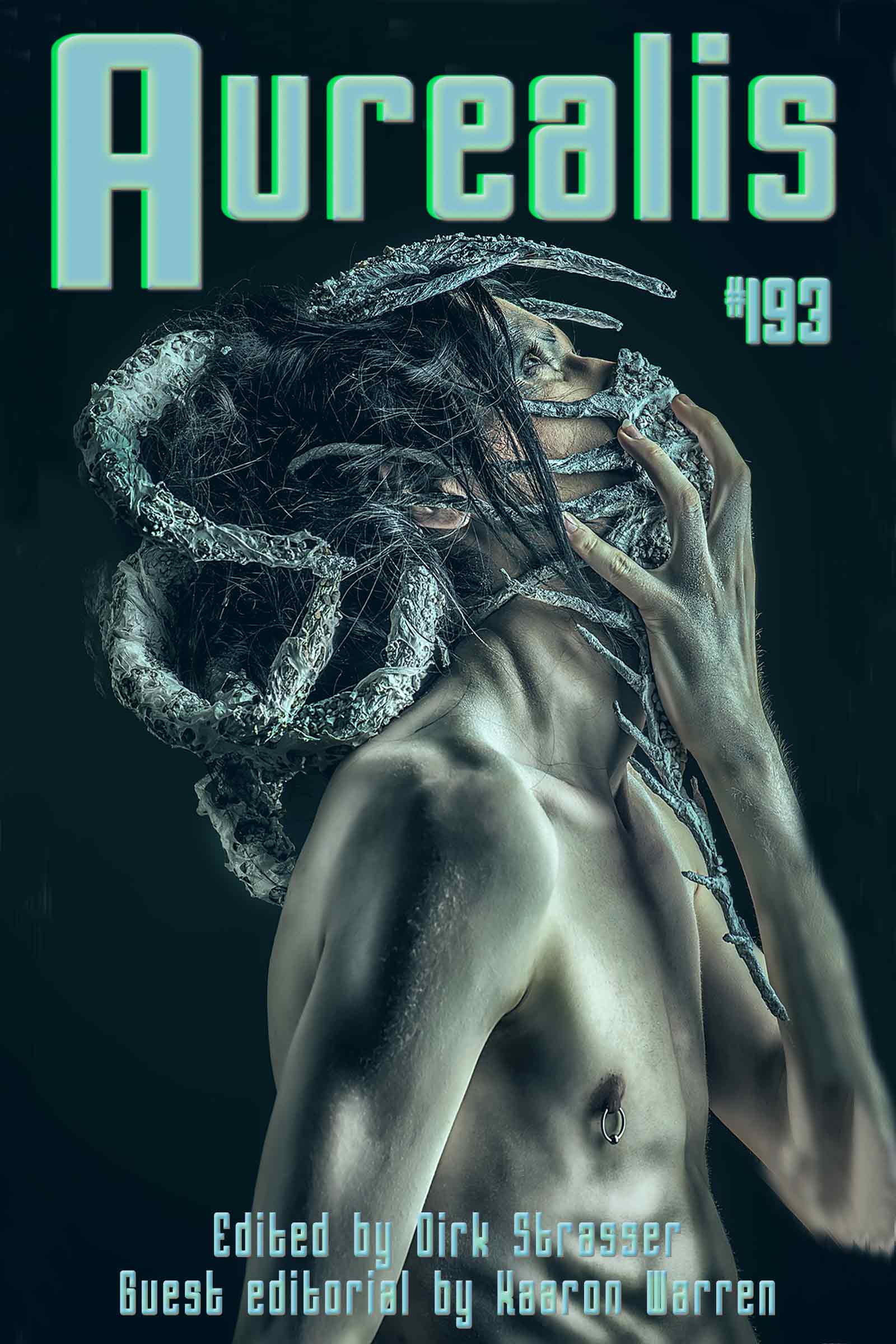
Aurealis #193
$3.99
Join us for our August issue Aurealis #193 where Kaaron Warren curses the darkness as she dissects why she loves horror in her guest editorial. Jocasta Suzanne and Maddison Stoff combine to give you ‘The Map and Territory’, an intriguing alien-contact story with a clever take on philosophy’s role in science fiction. Reunite with Kaaron Warren to see how the horror cruise story idea in her editorial comes to life (or is it death?) in ‘Song of the Stormy Petrel’. Neurocleric’s ‘Treasure Moon’ is a haunting exploration of family, loyalty, and betrayal. Our featured artists in this issue are Andrew Saltmarsh, Kim Lennard and Lynette Watters. The non-fiction offerings include Trevor Howis’ interview with the Melbourne-based writer of fantasy, horror and romance Keri Arthur, Emmet O’Cuana’s ‘The Orc’, and Paul Lonardo’ ‘I am Providence: A City’s Influence on Lovecraft and his Work’. Plus a whole heap of reviews. Why would you not get this issue?
- From the Cloud — Dirk Strasser
- The Map and Territory — Jocasta Suzanne and Maddison Stoff
- Song of the Stormy Petrel — Kaaron Warren
- Treasure Moon — Neurocleric
- The Orc — Emmet O’Cuana
- An Interview with Keri Arthur — Trevor Howis
- I Am Providence: A City’s Influence on Lovecraft and His Work — Paul Lonardo
Guest Editorial: Kaaron Warren
Horror is honest. It tells the truth about people, and the past. I love horror for this honesty. There might be hope woven through but there won’t be a happy ending, just for the sake of it, nor lessons learnt to prove a point. The story will go where it honestly needs to go and not hold back, no matter how dark the destination is.
I see the darkness everywhere. Most horror writers and readers do. We see between the cracks, and in the shadows. Beyond the mask. A love of horror means you have insight; you can see the monster beneath the veneer, and you are fascinated by it.
It’s always been this way with me. My classic example is a motivational quote from Mother Teresa my mother had printed and hung on our wall. It goes, ‘It is better to light a single candle than to curse the darkness.’
Nice, isn’t it? Do what you can, even a small action can help.
For me, I saw ‘Curse the Darkness’ and thought, that’s a brilliant title for a horror story. I must have been around twelve or thirteen, I guess. My mother was angry at me for seeing the darkness, and not the light, but I bet most horror readers and writers would see what I saw. I haven’t yet written that story but I started a poem with the title:
The hands were silent
The clock stood still
The man was quiet
And ready to kill
I see the darkness, the possibilities, everywhere. I have multiple boxes of news clippings and other ephemera, all waiting for the story. I have a tiny obituary of a man, dated in pencil with the words ‘his death’ in the margin.
I have a greeting card, written with a very shaky hand, from a couple on a cruise. It ends: ‘All OK with us, but lots of viruses, various, and staff therefore scarce.’
Staff therefore scarce!
I have a children’s educational magazine that tells me Michaelangelo left Florence because a friend had a ‘vision of the dead Lorenzo’. I want to write that story.
I see it. Do you?
I’ve been doing this for a long time, collecting images, inspirations, sparks. I collected clippings about Skylab in 1979 because it was incredible to me that this debris would drop and bring with it elements from outside our atmosphere. What could grow? My story ‘Air, Water and the Grove’, which won an Aurealis Award, came from this some 40 years later! Just as a stay in a rooming house in 1997 led to my novella Into Bones Like Oil (also an Aurealis Award winner), and a number of other stories. The imagery sits and waits. The thoughts do, too, waiting for the time the horror coalesces and I can get it on the page.
I haven’t used all of the inspirations I’ve mentioned yet. You can use them if you like; we’ll all come up with different stories, because we bring our own fears, history, memories, life experiences and prejudices to it. Our own language choices, our own nightmares. Your story about that cruise ship will be different from mine.
I love this about horror. We put ourselves into our stories, so they breathe.
Can you hear that rasping breath?
All the best from the cloud!
Kaaron Warren
From The Map and Territory by Jocasta Suzanne and Maddison Stoff:
Philosopher’s Log—Entering uncharted binary star system 12.32: Reggie from geology stopped by my bay again. He dropped a pile of rocks on my desk and told me to ‘philosophise his stones.’ I gave a quote from Aristotle and he seemed satisfied, but he left them with me. I heard him laughing in the hallway afterwards.
From Song of the Stormy Petrel by Kaaron Warren:
We were led through the introduction, the ‘Show Us your Deck’, if you will, by a woman who surely has seen the movie The Shining, and channelled Scatman Crothers.
From Treasure Moon by Neurocleric:
Me and Sis find the moon scat a few yards from the fella’s greased-upped body. There was a whole pile of the stuff dripping down the busted branches of a tupelo tree on the far edge of Crusted Swamp. The fella’s laying snoring and naked and full of the goo these howlers get after changing back when the sunless morning hits like a wet yawn. He’s the same fella from yesterday and the day before.
From The Orc by Emmet O’Cuana:
The orc is associated most strongly with JRR Tolkien’s series of novels The Lord of the Rings (1954–1955). Initially synonymous with the more recognisable fantasy fiends ‘goblins’, as featured in his earlier novel The Hobbit (1937), orcs became increasingly complex over the course of Tolkien’s published writing.
From An Interview with Keri Arthur by Trevor Howis:
I first met Melbourne author Keri Arthur in a green room at Supanova on the Gold Coast in 2012. When I asked what she wrote, Keri presented me with a copy of Full Moon Rising (2006) and replied ‘Vampires, Werewolves and Sex!’
From I Am Providence: A City’s Influence on Lovecraft and His Work by Paul Lonardo:
Like Lovecraft, I was born in Providence, Rhode Island, and I have long felt a certain affinity to him because of this happenstance of birth, as well as for a shared love of the macabre, which almost certainly is a prenatal condition unto itself.