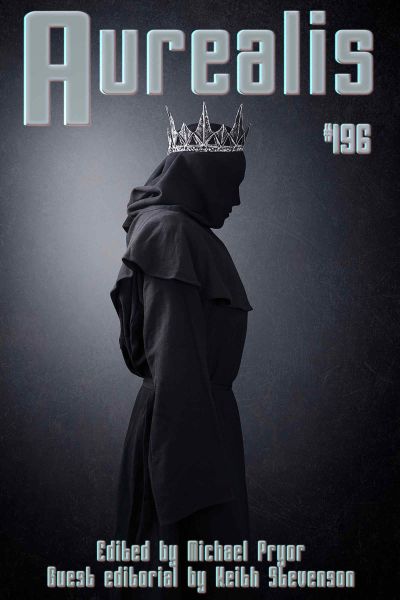
Aurealis #196
$3.99
Aurealis #196 presents ‘1up’ by Scott Steensma, ‘Zom’ by Greg Foyster and ‘Alacrity (For Glenda)’ by Stephen Higgins. Our non-fiction is ‘The Magic Realism of Barbara Comyns’ by Lynne Lumsden Green, ‘Is Ozploitation Dead?’ by Lachlan Walter and ‘Sinners: Why the True Horror is not the Vampires’ by Louise Zedda-Sampson. Guest editorial is by Keith Stevenson.
- From the Cloud — Michael Pryor
- 1up — Scott Steensma
- We of the Zom — Greg Foyster
- Alacrity (For Glenda) — Stephen Higgins
- The Subtle Magic Realism of Barbara Comyns — Lynne Lumsden Green
- Is Ozploitation Dead? — Lachlan Walter
- Sinners: Why the True Horror is not the Vampires — Louise Zedda-Sampson
Is Writing Dead?
The short answer is: not yet. The magazine you hold in your hand, filled with a wonderful collection of imaginative fiction, is proof of that. The longer answer is more complicated.
The year 2025 was very bad for authors. Most obviously because the Australian Productivity Commission tried to set aside copyright—and any claim for fair recompense by Australian authors and other creatives—so that multi-billion-dollar tech companies could suck up their collective works to feed the large language models that fuel their artificial intelligence programs. Thankfully, that move was quashed by the Australian government, but not without a lot of effort from author organisations and individuals to get a fair settlement. But running underneath all that was another threat to authors posed by generative AI. And that is the growing number of novels fully or partially generated (I won’t say ‘written’) by AI that are flooding the market.
A market that is already hard enough to sell books in.
I’m not anti-science. I’m a science fiction writer and my latest novel—The End Times of Markusz Zielinski—is in many respects a celebration of science. There are many legitimate and worthwhile uses for AI. It has revolutionised medical imaging, for one thing, with the gold standard for image assessment now being a human radiologist paired with a specifically trained AI. It’s useful for administrative tasks too, or anything that is repetitive in nature. But there’s something it will never be as good at as humans, and that is creativity. In writing, in painting, in music, in any artistic discipline.
Celebrated Australian illustrator and author Shaun Tan commented on AI-generated art in a recent Guardian interview. He said, ‘The AI doesn’t get it. It’s a superficial simulation—it’s like they know the symptoms, but they don’t know the disease.’
I recently attended a lecture on AI by Toby Walsh, Chief Scientist at the AI Institute of the University of NSW in Sydney, where he spoke about AI and creativity. He gave, as an example, the opening sentence of George Orwell’s dystopian classic 1984: ‘It was a bright cold day in April, and the clocks were striking thirteen.’
Walsh said that until Orwell wrote that line, no AI program could have generated it, because all they can do is select and provide the next most likely word in any sentence, and no one—until Orwell—had written that a clock struck anything other than a number between one and twelve.
According to Walsh, artificial intelligence is not and can never be like human intelligence. The clue’s in the name: ‘artificial’. No AI will ever generate something original that captures the human experience, because it will never understand what it means to be human (as far as it can ‘understand’ anything).
So back to the initial question: is writing dead? Not if we push back and demand stories written by humans. Stories that are the result of a human mind struggling to understand and express concepts that entertain us, while making us reflect on the world, the past, the future, the connections between ourselves and others.
Stories that matter.
As we move into 2026, the signs are good. Many people are pushing back against ‘AI slop’. The simple act of reading this magazine means the authors whose work it contains are encouraged to keep going. So, thank you. I hope you continue to enjoy the journey.
All the best from the cloud!
Keith Stevenson
From 1up by Scott Steensma:
All things considered, the night of my death went pretty well. For one, I got lucky, and for two, there are worse places to check out than a party at Jake’s.
From We of the Zom by Greg Foyster:
We’re out drinking in Kings Cross when Jax suggests we stop for churros.
From Alacrity (For Glenda) by Stephen Higgins:
The contrast was startling. Keith walked the length of the street and, every time he moved out of the sun and into the shade, he felt his eyes took far too long to adjust.
From The Subtle Magic Realism of Barbara Comyns by Lynne Lumsden Green:
Barbara Irene Veronica Comyns Carr—born Barbara Irene Veronica Bayley—was a leading proponent of the British Magical Realism literary genre.
From Is Ozploitation Dead? by Lachlan Walter:
The Ozploitation boom, beginning in the early 1970s and wrapping up in the late 1980s, remains one of the defining periods of both Australian film and Australian genre fiction.
From Sinners: Why the True Horror is not the Vampires by Louise Zedda-Sampson:
The horror movie Sinners (2025) garnered many industry awards, the most important being the 16 Oscar nominations: a record for any horror movie in the Oscar’s 98-year-long history, and a record for any movie—full stop.